1. Background
Giovanni Eroini owns a house located in the municipality of Samedan, which he purchased in 2019 at a market value of CHF 920,000. While the ground floor, which he rents out, houses a hair salon, he lives on the first and second floors with his wife and two children. The attic is neither insulated nor finished and serves as a storage space. The property is part of Giovanni Eroini’s private assets.
In 2020, Mr. Eroini had his house—excluding the ground floor—remodeled and renovated. Accordingly, he claimed the costs for the following investments on his 2020 tax return:
a) The walls throughout the house were freshly painted. The hardwood floors in the bedrooms were replaced.
b) In the living room, the old wall-to-wall carpet was removed and replaced with oak hardwood flooring.
c) A wall between the living room and the kitchen was removed, and a fireplace was installed.
d) The attic was insulated to reduce energy consumption. It continues to be used as a storage space.
e) Alternative to item d): The attic was not only insulated but also converted into an apartment.
- How should the maintenance and renovation work carried out by Mr. Eroini on his house be assessed from a tax law perspective? Which expenses can he deduct for tax purposes?
- Which date is decisive for the deductibility of value-preserving investments: the invoice date or the payment date?
- What is the legal situation if Mr. Eroini inadvertently fails to report certain value-preserving investments on his tax return and therefore claims them as value-enhancing investments years later upon sale?
2. Alternative Scenario 1
After the hairdresser terminated the lease, Mr. Eroini had his house extensively renovated. According to the construction invoice, the total costs amount to CHF 1,025,000. Following the renovation or complete refurbishment of his house, a new official appraisal was conducted, which showed a market value of CHF 1,920,000.
Specifically, Mr. Eroini makes the following investments:
- On the ground floor, he has the hair salon converted into a 5-room apartment.
- On the first floor, he is having an interior wall removed to create a large kitchen-dining area. He is also having a balcony built.
- He is having the second floor completely gutted and the layout redesigned.
- The stairwell is being relocated from the interior to the exterior.
- The attic will be insulated and converted into an apartment.
- How should Mr. Eroini’s investments be classified for tax purposes?
- Are any potential demolition costs (e.g., removal of electrical installations) tax-deductible?
3. Alternative Scenario 2
After purchasing the house in 2019, Mr. Eroini decided against a complete renovation. Instead, two years after buying his house—during the 2021 tax year—he installed a photovoltaic system (on the roof of his house) with a battery storage unit. Its capacity is less than 100 kWp (kilowatt-peak). In addition, he had the house fully insulated (including the roof), installed new windows, completely covered and glazed the patio to expand the living space, and installed a new kitchen.
Costs incurred:
- Photovoltaic system with a battery storage unit: CHF 60,000 (of which CHF 15,000 is for the battery storage unit). Mr. Eroini has been awarded subsidies, specifically a one-time payment of CHF 18,000 (Small One-Time Payment, KLEIV), from the Canton of Graubünden for the construction of the photovoltaic system. The one-time payment under Art. 25 of the Energy Act (EnG) has replaced the cost-covering feed-in tariff (KEV, Art. 7a aEnG).
Since 2018, KLEIV payments have been available for photovoltaic systems with a rated output of less than 100 kWp. Operators of systems with an output of 100 kWp or more can apply for a large one-time payment (GREIV).
- Insulation of the entire house: CHF 400,000.
- New windows: CHF 50,000.
- Roofing and glazing of the patio to expand living space: CHF 25,000.
- Kitchen replacement: CHF 30,000.
Net income (= total income minus production costs and general deductions [before social security deductions]) of Mr. Eroini for the 2021 tax year, before taking the above-mentioned costs into account: CHF 145,000.
- Can investments intended to save energy and protect the environment be deducted for tax purposes? In which cases?
- a) Is Mr. Eroini’s investment in the photovoltaic system and the battery storage unit one that serves to save energy and is therefore tax-deductible?
b) What would the legal situation be if Mr. Eroini were to install the photovoltaic system not on the roof of his house but in his garden?
3. What are the tax implications of the KLEIV in the amount of CHF 18,000?
4. What would be the legal situation if Mr. Eroini had claimed the entire investment for the photovoltaic system, amounting to CHF 60,000, as a deduction when he made the payment in 2021, but did not receive the KLEIV payment of CHF 18,000 until 2022?
5. How do you assess the expenses for insulating the entire house, for the new, more energy-efficient windows, for the roofing and glazing of the patio to expand the living space, and for replacing the kitchen?
6. What is the amount of the costs related to energy conservation and environmental protection that Mr. Eroini was unable to fully deduct in the 2021 tax year? What specific claim can Mr. Eroini file regarding these costs?
7. Why might the question of whether incurred property costs are (merely) for the purpose of maintaining value or serve energy conservation and environmental protection be significant?
8. What is the legal situation regarding the costs of the photovoltaic system in the case of a complete renovation?
4. Scenario 3
Mr. Eroini does not use all of the electricity he generates for his own consumption. He feeds the surplus energy into the grid. In return, he receives a feed-in tariff (so-called “feed-in compensation”) of 10 from the relevant utility company.
- How is the feed-in tariff treated for tax purposes?
- Mr. Eroini’s photovoltaic system does not generate enough energy, particularly during the winter months. As a result, he purchases 6 worth of energy from the utility company.
What is considered taxable income in this case?
5. Scenario 4
Mr. Eroini holds his property as business assets. It should be noted here that operating a photovoltaic system on a property that one lives in generally does not constitute self-employment.
- Which provisions apply in this scenario—both in general and with reference to the basic facts and Scenario 1?
1. Basic Facts
Stefanie Ernst is the owner of a property located in the city of Zurich (Sihl Manegg), which she inherited in 2009 from her mother, who had since passed away. At the time of inheritance, the debt-free property was appraised by Wüest & Kunz at CHF 7,800,000.
At the time of the inheritance, Stefanie’s childhood home stood on the property, where her mother, Mrs. Ernst, had lived until her death. The manufacturer’s villa, built in the 1890s, has always been in the family. It featured extensive grounds and was ideally located between the Sihl River, the highway, and the Sihltalbahn railway. The sprawling park is beautifully nestled between two branches of the Sihl River and is surrounded by mature trees.
However, her parents’ financial situation in recent years no longer allowed for major renovations. It was sufficient, however, for necessary maintenance. At the time of her mother’s death, the property was in modest but livable condition. The same was true of the grounds, which required a great deal of care and maintenance.
Thanks to her solid personal financial situation, Stefanie was able to realize her dream and carefully restored the villa between 2010 and 2013. She invested primarily in energy-saving and heat-insulating features. In addition, an elegant swimming pond was added to the grounds, and the antique pavilion was completely upgraded to meet today’s energy efficiency standards. A detailed breakdown of the energy-efficiency and value-enhancing measures, as well as the construction of the new pool, totals CHF 2,200,000.
The villa is located in the heart of a long-term pilot project for the 2,000-watt society. Urban living and high-density housing are on the rise. Steadily rising real estate prices, falling interest rates, and, ultimately, the neighborhood’s development led Stefanie to join the local project development in 2015 and develop the property in collaboration with a general contractor.
Four stylish apartment buildings, each with 7 units (90 square meters each), were built on the property. Based on the planned sale of the individual units, the estimated market value totals CHF 42,840,000; construction costs amounted to approximately CHF 12,600,000.
Stefanie Ernst intends to sell between three and ten apartments directly to friends and acquaintances and to rent out the rest.
- What tax issues or topics generally arise for Stefanie Ernst in connection with the sale of the apartment buildings?
- How are the real estate gains tax and the relevant acquisition costs calculated?
2. Alternative Scenario 1
As part of the planning for the apartment buildings, a requirement was imposed to preserve the exterior of the historic manufacturer’s villa, including the natural pond. Regarding the Neo-Rococo garden pavilion with its herringbone oak parquet flooring, ornate stucco work, and marble cladding, the historic preservation authorities became involved.
Ms. Ernst reached an agreement with the authorities that the pavilion would be preserved true to the original, but could be relocated within the existing property. The corresponding historic preservation work amounts to approximately CHF 500,000.
Accordingly, three apartment buildings can still be built on the remaining lot. The manufacturer’s villa was lovingly integrated into the project and converted into modern office space. Stefanie Ernst intends to sell between three and ten apartments directly to private individuals she knows and to rent out the rest.
Given the highly attractive office space, the total proceeds (from the villa with offices and the three apartment buildings) could amount to approximately CHF 37,000,000. Construction costs remain unchanged at approximately CHF 12,600,000.
- Will the new land-use planning and historic preservation requirements result in any changes to the amount of property gains tax or the tax base?
3. Scenario 2
In 1992, Stefanie Ernst’s mother inherited a substantial fortune from her sister in the United States. She decided to move from the old villa to a modern city apartment, which she had renovated to make it suitable for her age.
She continued to tend the garden surrounding the industrialist’s villa as a hobby. However, she allowed the villa itself—which had been severely neglected for years—to fall into disrepair. The industrialist’s villa now served only as a home for birds, foxes, and mice. The pavilion was mostly overrun by pigeons.
In this condition, Stefanie Ernst inherited the property on the Sihl in 2009. Since she had been living in the U.S. with her partner since 2005, the property lay fallow for many years. The villa served as a hedgehog rehabilitation center for ProNatura.
In 2015, Ms. Ernst decided to implement the project described at the beginning (basic facts) and to proceed as outlined in the above description.
- Does the fact that both Ms. Ernst’s mother and Stefanie Ernst completely neglected the property affect the investment costs for property gains tax in any way?
1. Basic Facts
In January 2022, Ms. Zürcher (a widow) transferred an (unencumbered) 15,000 m² building lot on the outskirts of Zurich to her two descendants. There are no other legal heirs. The contract (contract for transfer of ownership—mixed gift) stipulated, among other things, the following:
- Payment of a purchase price of CHF 15,000,
- The property is acquired by the descendants “as a result of an anticipated community of heirs with joint ownership in equal shares,”
- The portion of the gift is not subject to equalization in Ms. Zürcher’s estate,
- All tax liabilities related to this property are to be borne by the descendants. Should such taxes be imposed on Ms. Zürcher, the descendants must indemnify Ms. Zürcher.
Ms. Zürcher, together with her brother, Mr. Berner, received this property in equal shares in 2000 from their mother (who died in 2002) as a gift. Their mother had been the sole owner of the property since before 1960. In 2011, Mr. Berner (who is childless and unmarried) transferred his share to Ms. Zürcher by way of a gift. No gift tax or real estate gains tax was levied at that time.
The building lot is currently lying fallow (undeveloped meadow) and has thus far been taxed based on its income value. It constitutes private assets for each of the individuals mentioned, and it has not been subject to the provisions of the Federal Act on Agricultural Land Law for several decades. There has been no rezoning (improvement of land use potential) since 2021.
The following values are available:
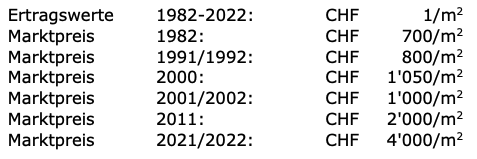
- The descendants intend to construct four apartment buildings on this parcel. These are to be rented to third parties (no (partial) sale is intended). To assess the project’s financial viability, they would like to know what taxes they will be liable for in connection with the construction project and the amounts involved. The analysis should be based on the assumption that construction will begin at the end of December 2022.
- No later than upon completion of the construction project, each of the two heirs intends to retain sole ownership of two apartment buildings. It is assumed for the purposes of this analysis that the individual apartment buildings are of identical value, each with an equal share of the land, and that the increase in value resulting from the construction project corresponds to the investments made. They do not wish to establish condominium ownership for any of the apartment buildings. They would like to know when the division should take place without incurring additional taxes.
Scenario 1
Ms. Zürcher is not a widow but is married. The remaining facts remain unchanged; in particular, the parcel will be transferred only to the two descendants in 2022.
- Does this scenario change the tax consequences regarding the division of the parcel by the descendants?
Scenario 2
The walls of an old (no longer usable) barn still stand in the middle of the parcel. As described in the base scenario, the parcel is taxed at its income value (CHF 1/m²) as part of the private assets. Likewise, the remaining elements of the scenario remain unchanged compared to the base scenario.
- Investigations have shown that subdividing the parcel while the barn is still standing would be costly, as the new property line runs right through the middle of the barn. The heirs would therefore like to know whether it makes sense from a tax perspective to wait until the barn has been demolished or removed before proceeding with the subdivision.
1. Basic Facts
A is the owner of the developed property x. The development costs of the property amount to CHF 20 million, and the market value is CHF 30 million. Behind property x is a slightly elevated property y owned by B. B wishes to ensure that she retains her beautiful view of the Alps and proposes to A that he grant her an easement (restrictions on vegetation and building height) in favor of her property y and at the expense of his property x. In return, B offers A CHF 1 million. A agrees. A corresponding easement agreement is concluded, and the easement is entered in the land register.
- How should the compensation of CHF 1 million be treated for tax purposes for A?
- Can B claim the payment as a deduction for tax purposes, and if so, under which type of tax?
2. Alternative Scenario 1
The property x is located on Lake Greifensee in the canton of Zurich and is built on only by a small, old single-family home. The larger portion is undeveloped, specifically the entire right half (as viewed from the lake). Thanks to the sparse development on property X, B enjoys a lake view from her property Y. She wishes to preserve this view for her property Y and proposes to A that a building restriction be established for the undeveloped half of property X as an easement in favor of her property Y and at the expense of property X. In return, she offers a payment of CHF 3 million. A agrees to the deal. The purchase price of the entire property (excluding buildings) was CHF 2 million; its current market value (excluding buildings) is CHF 8 million.
A few years later, A receives an extremely attractive offer from a prospective buyer for property x. However, the buyer is willing to purchase it only if the building restriction is lifted beforehand. B has since passed away, and her heirs, who live abroad, have leased property y and are no longer interested in it. A offers the heirs CHF 3.5 million to have the building ban lifted. The heirs accept the offer.
- How should the compensation of CHF 3 million for the building ban be treated for tax purposes in A’s case?
- How should the CHF 3 million compensation for the building ban be treated for tax purposes for B?
- How should the lifting of the building ban be treated for tax purposes for the heirs?
- How should the lifting of the building ban be treated for tax purposes for A?
3. Alternative Scenario 2a)
Property X in the canton of Zurich is undeveloped. A grants B a building right on Property X, for which B pays a one-time compensation of CHF 1 million and an annual building right fee of CHF 30,000.
The structure of the building right is as follows:
- Sub-scenario 1: Irregular personal servitude, i.e., a building right in favor of B that is transferable and inheritable, with the maximum permissible term of 100 years. In this Subvariant 1, B subsequently sells the building right to C for CHF 100,000;
- Subvariant 2: Regular real servitude, i.e., a building right in favor of B that is neither transferable nor inheritable;
- Subvariant 3: Real servitude, i.e., a building right encumbering parcel x and benefiting the neighboring parcel y.
- How should the compensation for granting the building right be assessed for tax purposes for the recipient under the various legal structures?
a. Irregular personal servitude
b. Regular personal servitude
c. Regular personal servitude
2. How should the resale of the building right be treated for tax purposes in Subvariant 1?
4. Scenario 2b)
Facts as in Scenario 2a, but Plot x is now developed. B pays A, in addition to the aforementioned amounts (lump-sum compensation and annual building right rent), compensation of CHF 500,000 for the existing building. Sub-scenarios as in Scenario 2a).
- How should the one-time compensation of CHF 500,000 for the existing building be treated for tax purposes in sub-scenarios 1 through 3?