- Individuals
Tax and Estate Planning: The German Perspective

Note: This language version is an automatically generated translation. The text may therefore contain linguistic and terminological errors.
view in original language (German)Note: This language version is an automatically generated translation. The text may therefore contain linguistic and terminological errors.
view in original language (German)This seminar examines the tax challenges arising from cross-border relationships between Germany and Switzerland. It focuses on German gift and income taxes, the “Hinzurechnungsbesteuerung” (add-back taxation), and exit taxation in the context of equity investments and carry structures. Using practical case studies, the seminar highlights tax risks and structuring options from a German perspective.
A is a German citizen and has been living in Switzerland for two years. His friend B, who is also a resident of Switzerland, is planning to finance an investment project. To support him, A grants B a loan of 1 million EUR. The loan is unsecured. A and B agree on an interest rate of only 2% per annum. No further consideration from B is anticipated.
In the same year, A also transfers EUR 250,000 to a foundation in the canton of Graubünden. Under Swiss law, the foundation pursues exclusively charitable purposes and is recognized in Graubünden as tax-exempt. The funds are to be used for projects in the field of promoting education and science.
Does the granting of the loan or the donation trigger German gift tax?
A also holds stakes in two corporations with their registered offices and management in Switzerland (see the chart below). A wishes to contribute his stake in AA AG to AC AG and, in return, receives new shares in AC AG, so that his stake will ultimately be 55% instead of the previous 50%.
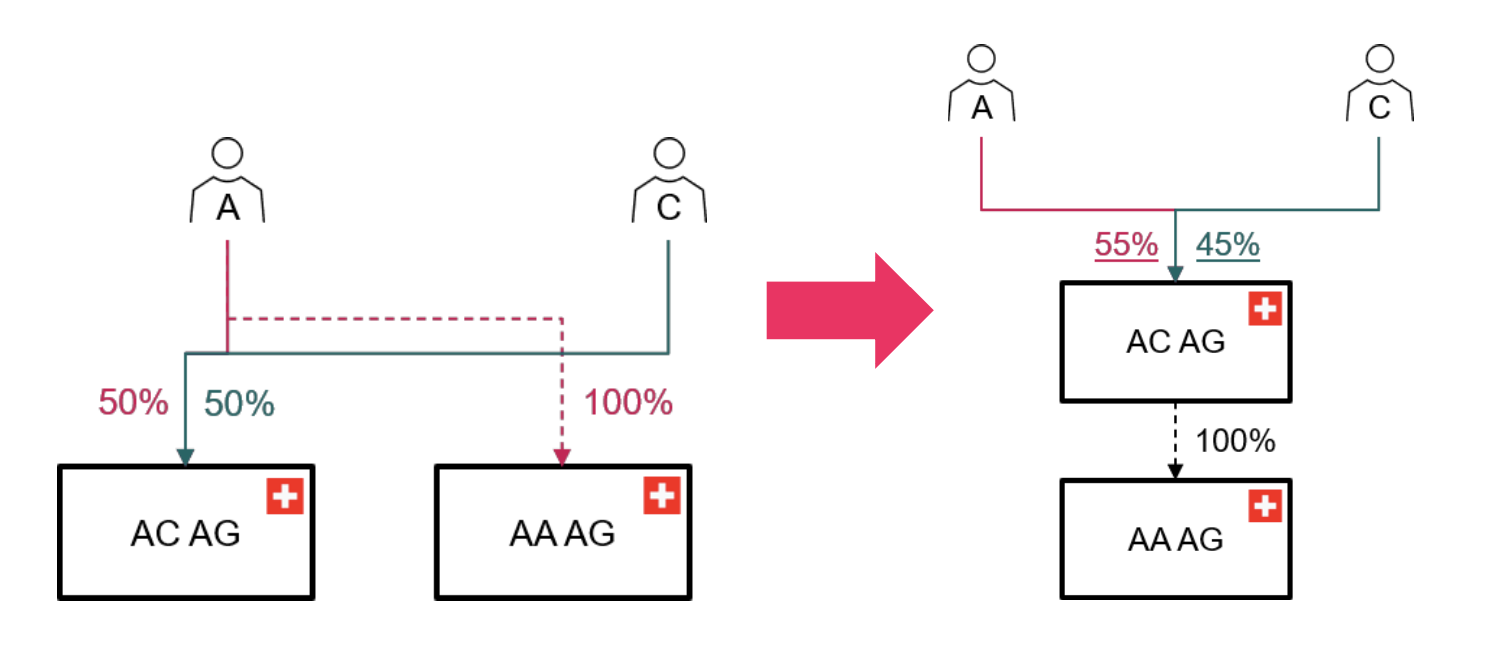
Is this transaction subject to German gift tax?
A lives with his wife and their children in a single-family home in Zurich, which is also the center of his personal life.
A is a U.S. citizen and holds a securities account at a bank in New York, from which he receives dividends and gains from the sale of shares in U.S. corporations.
A is employed as an engineer at a German automobile manufacturer in Munich. As a result, A regularly stays in Germany for work and uses a company-provided residence in Munich that is made available exclusively to him for this purpose.
A is a resident of both Germany (company-provided housing) and Switzerland (family home). His center of life is in Switzerland. He holds 100% of the shares in each of two corporations based in Switzerland: Immobilien AG and Freiberufler AG. Immobilien AG leases its own Swiss real estate to third parties and maintains its own staff and business premises in Switzerland. Freiberufler AG bills third parties for consulting services provided primarily by A personally. A performs these consulting services exclusively from a place of business in Switzerland.
A is exclusively a German national and has been subject to unlimited tax liability in Germany for more than ten years, working as a manager of several private equity funds. He holds direct interests in several “carry” companies domiciled in Luxembourg in the legal form of SCSp, which are treated as tax-transparent entities and provide him with disproportionately large shares of profits upon the successful sale of the fund investments. A holds these interests as part of his private assets. A completely relinquishes his domicile and habitual residence in Germany, moves permanently to Switzerland, and will henceforth conduct his business primarily from there. The carry companies and the underlying funds will continue to be managed in Luxembourg; the holdings will remain in place even after his move.
