1. Facts of the Case
A holds all shares in Hotel AG as part of his private taxable assets. The corporation operates a hotel in its own building. A sells his shares to B.
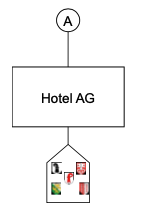
Questions
What are the real estate gains tax and transfer tax implications in the following scenarios:
- Question a): At the time of the sale, the hotel business is active. The buyer, B, continues to operate the hotel through Hotel AG.
- Question b): At the time of the sale, the hotel business is active. The purchase price consists of a real estate component of CHF 4 million and a component for the hotel business of CHF 1 million. The buyer, B, attempts to continue operating the hotel using various business models but is forced to cease operations two years later due to poor business performance, including the effects of the COVID-19 lockdown. The property is intended to be used for other purposes in the future, and conversion into an office building is also a possibility.
- Question c): At the time of the sale, the hotel business is active. Purchaser B sells the hotel operations to C for 1 million immediately after purchasing Hotel AG (additional information: the property has a market value of 4 million), with B and C (or their respective corporations) entering into a lease agreement with each other. As a result, Hotel AG becomes Immo AG with a corresponding change in purpose.
- Question d): At the time of the sale, the hotel business is in principle still operational; however, due to an accident involving the managing director (who is also shareholder A), the hotel has already been closed for two months. A is forced to sell his beloved hotel quickly due to health problems. The buyer, B—who has known the hotel for years and often visited it herself as a child—does not yet have clear plans regarding whether and for how long the hotel business should continue, even though A would like Hotel AG to continue operations.
- Question e): At the time of the sale, the hotel is in operation. However, the buyer, B, ceases hotel operations within three months and simultaneously submits a building permit application for a new office building. The purchase price offer was based on a property valuation, whereby, from the buyer’s perspective, no additional value was attributed to the business or the hotel inventory.
- Question f): Hotel AG has existed since 1932 and has owned the property ever since. Shortly before the sale, hotel operations are discontinued. The buyer, B, does not yet have clear plans for how the property will be used in the future but insists on taking over all the furnishings. Currently, the focus is on a “light version of a hotel” (short-term rentals of furnished apartments with concierge and weekly cleaning service). According to the most recent balance sheet, the residual book value of the property accounts for 60% of total assets (or 95% when considered at market value).
1. Background
Immo AG, Zurich, holds four parcels of land on its balance sheet. The properties are located in the cantons of Baselland, Bern, Geneva, and Solothurn and are leased to independent third parties. Immo AG is wholly owned by HoldCo. HoldCo, in turn, is wholly owned by TopCo. TopCo is owned by an individual.
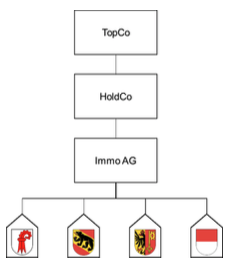
Questions
- HoldCo is selling Immo AG. What are the implications of this sale with regard to real estate gains tax and transfer tax?
- What tax consequences does the sale of Immo AG by a natural person have with respect to the property in the canton of Geneva, and what measures must be taken at the Immo AG level?
- TopCo sells HoldCo. What are the consequences of this with regard to real estate gains tax, transfer tax, and income tax for the properties in the cantons of Baselland, Bern, Geneva, and Solothurn?
2. Alternative: Mixed “Real Estate Holding Company”
HoldCo holds all shares in Immo AG. In addition, HoldCo’s balance sheet includes a property located in Baselland.
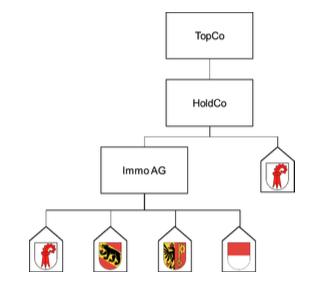
Question
- TopCo sells HoldCo. What are the implications regarding real estate gains tax, transfer tax, and income tax for the properties in the canton of Baselland, compared to the initial scenario?
1. Facts
A, B, C, and D hold minority stakes in Immo AG as part of their private taxable assets. Immo AG owns real estate in the cantons of Baselland, Geneva, and Zurich.
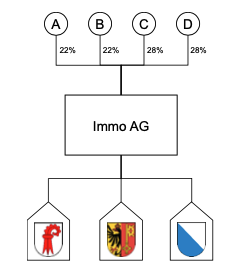
Questions
- Question a): A sells her shares to C. What are the real estate gains tax implications of this transaction?
- Question b): A, B, and C sell their shares to D at the same time. What are the real estate gains tax implications of this transaction?
- Question c): D buys the shares from B. Two years later, D buys the shares from A, and four years after that, those from C. What are the real estate gains tax implications of this?
- Question d): E contacts the board of directors of Immo AG and makes an attractive but time-limited offer to purchase Immo AG, even though the shareholders had no plans to sell. The board of directors informs shareholders A, B, C, and D, who are at odds with one another and do not communicate with each other—or do so only in emergencies. The board of directors does not conduct any further in-depth investigations and merely notifies E of the individual shareholders’ consent. The purchase goes through. What are the real estate gains tax implications of this?
- Question e): C and D want to sell a portion of their shares within the family to A and B. In a first step, they reduce their holdings by half. A offers more than B, purchases an additional 14% each, and thus now holds 50%. Four years later, C and D decide to sell the remaining shares to the highest bidder as well. A purchases the remaining shares and now holds 78%; B remains a minority shareholder with 22%. Unfortunately, B was unable to match A’s bid, even though A was determined to acquire the shares in order to achieve a balanced ownership ratio. What are the real estate gains tax implications of this?
1. Facts
TopCo, headquartered in Luxembourg, holds all shares in Immo AG, Bern. Immo AG owns two properties located in the canton of Bern. All of the properties were acquired by Immo AG in a taxable transaction in 2010.
TopCo is a company with sufficient substance in Luxembourg for the purposes of Swiss real estate gains tax.
The following transactions are now being considered:
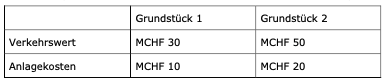
- Step 1: TopCo sells all of its shares in Immo AG to BidCo, which is tax-resident in Switzerland. The values relevant for real estate gains tax purposes are as follows:
- Step 2a: BidCo sells the shares in Immo AG to a third party
- Step 2b (Alternative A): Immo AG sells the real estate to a third party in an asset deal.
- Step 2c (Alternative B): Immo AG merges with BidCo in a tax-neutral transaction (subsidiary absorption), and the properties are subsequently sold by BidCo in an asset deal.
The values relevant for real estate gain taxes in steps 2a, 2b, and 2c are as follows:

Questions
- How is Step 1 treated from the perspective of Bern’s real estate gains tax?
- What are the gains relevant for Bern real estate gains tax purposes resulting from steps 2a, 2b, and 2c?
1. Facts
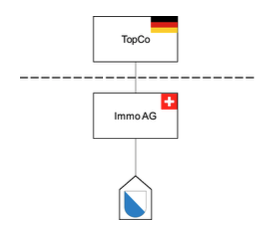
TopCo, headquartered in Germany, holds all shares in Immo AG, Zurich. Immo AG owns a piece of real estate located in the City of Zurich. The property was acquired by Immo AG in a taxable transaction in 2010. The acquisition cost is MCHF 50, and the current market value of the property is MCHF 100.
TopCo is an operating company with sufficient substance in Germany for the purposes of Swiss real estate gains tax.
Question
Is real estate gains tax levied in the Canton of Zurich, and on what capital gain?
1. Facts
Swiss investors in a contractual investment fund (“Fund”) with direct real estate holdings jointly sell the majority of the shares to the purchaser.
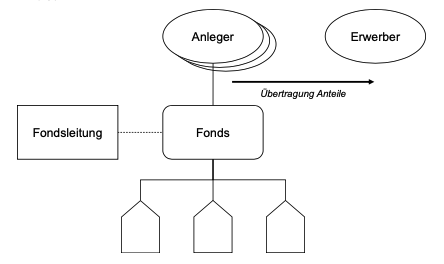
This scenario is likely to become increasingly significant, particularly with the introduction of the L-QIF (Limited Qualified Investor Fund).
Questions
- Does the transfer constitute an economic change of ownership that could trigger real estate gains tax or transfer tax? Who would be the taxpayer?
- Does anything change if the majority stake in the fund management company is sold?
- Do property gains tax and transfer tax obligations change if the real estate is held indirectly (through a real estate company)?
1. Facts
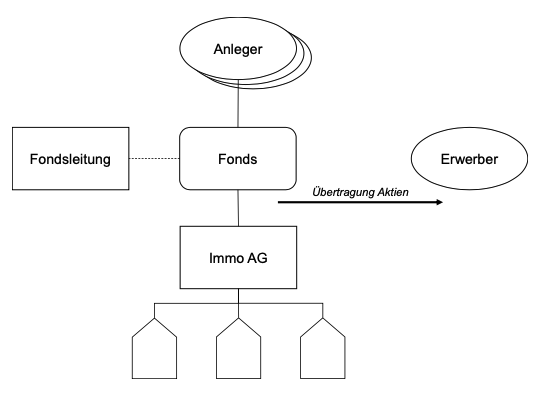
The contractual collective investment scheme (“fund”) holds its real estate in Switzerland indirectly through “Immo AG.” The investors are institutional investors. The shares in Immo AG are now being sold to the purchaser.
Question
- What are the implications regarding real estate gains tax and transfer tax at the level of the fund, the investors, and the fund management company (subject to the relevant cantonal/municipal legal framework)? Please address only the status as a potential taxable entity.
1. Facts
A collective investment scheme (contractual investment fund) holds real estate in the cantons of Fribourg, Geneva, and Vaud. The fund is managed by Fund Management Company A.
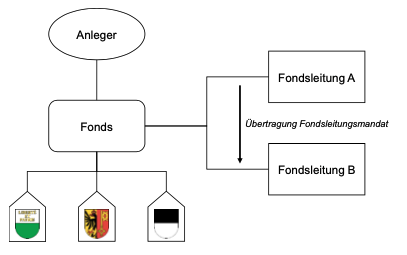
Question
- Fund Management Company A transfers management of the fund to Fund Management Company B, which is an independent third party. What are the implications of this with regard to transfer tax?