1. Facts of the Case
B AG, headquartered in Winterthur, sells its property in Zurich-Altstetten in 2022. Since it reports an operating loss, it files a request to offset the property gains tax. The following data are known:

B AG is headquartered in Frauenfeld.
- What portion of the gain from the sale of the property will be subject to income tax?
- Will the value fluctuation reserve be reviewed by the cantonal tax office or by the Zurich property tax authority? Why?
- Assuming the fair value adjustment reserve is accepted, what is the amount of the capital gain that would be subject to tax?
- What needs to be considered or calculated before submitting the application to offset the operating loss against the capital gains tax?
- What considerations should be taken into account regarding the company’s future and the application to offset the operating loss against the capital gains tax?
- What should be considered regarding the timing of the assessment procedures (income tax and real estate gains tax)?
1. Facts
An individual working as a cleaning staff member purchased six properties over the course of eleven years (2001–2012) and sold four properties over the course of six years (2006–2012), two of which underwent extensive renovations prior to sale. All real estate purchases were fully financed with debt. In one case, the proceeds from the sale were reinvested. Furthermore, the taxpayer owned a real estate corporation.
Prior to each sale, the individual resided in the properties for a certain period of time.
- Which of the criteria defined by the Federal Supreme Court for the existence of commercial real estate trading are met?
- Is this considered commercial real estate trading? What are the arguments for and against?
- Is the stake in Immobilien AG considered business assets?
1. Facts
General Contractor AG, headquartered in the canton of ZG, is selling a property in the canton of BS. For real estate gains tax purposes, instead of the required 12% flat-rate overhead allowance, only an allowance equal to 8% of the sales proceeds is granted. General Contractor AG is pursuing the matter through the appellate courts, arguing that the denial of the 12% flat-rate allowance for general expenses results in prohibited double taxation due to the higher property gains tax rate in the canton of BS compared to the income tax rate in the canton of ZG.
This case does not involve a legal entity, but rather an architect claiming credit for services rendered personally.
- Under what conditions can the tax authority set a lower flat rate?
- The Zurich Department of Finance states in its “Cantonal Tax Office Bulletin on the Deduction of Special Expenses for Professional Real Estate Dealers in Connection with Real Estate Gains Tax” that a flat rate of 5% of the sales proceeds may be granted to real estate dealers based outside the canton. Does this apply without exception?
- Is Generalunternehmer AG subject to double taxation?
- How and when are accepted self-performed services subject to taxation?
- Which tax jurisdiction covers the in-kind contributions?
1. Facts
A self-employed architect holds a stake in a limited partnership that owns 30 properties. He has built or renovated various properties in his own portfolio.
He sells one of his properties to the owner of the neighboring lot. He had previously filed a building appeal against this owner regarding a planned replacement new construction. The neighbor then offered to buy his property.
The architect disputes that this constitutes business assets. He claims he purchased the sold property “for the love of architecture.” No renovations were made to this property, and the external financing was not excessive.
- Which of the criteria defined by the Federal Supreme Court for the existence of commercial real estate trading are met?
- Is this a case of commercial real estate trading? What are the arguments for and against?
- If the Federal Supreme Court does not conclude that commercial real estate trading is taking place, what impact would the decision have on the consortium’s interest and the other properties?
1. Facts
A-Immobilien AG has owned an apartment building in Adliswil, ZH, since 1990. In 2000, two apartments were built in the spacious and previously unused attic.
For the sake of simplicity, the costs incurred were not capitalized but were instead recorded in the income statement as real estate expenses.
The property in Adliswil will be sold in 2022. The following data are known:
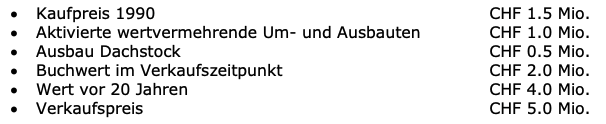
For real estate gains tax purposes, A-Immobilien AG uses the market value from 20 years ago. For income tax purposes, the difference between the original and current book value—amounting to CHF 0.5 million—is taxed as recaptured depreciation.
- What is the issue with this accounting treatment?
- How should the acquisition costs be calculated?
- What would the situation be if, during the 2000 assessment, the tax authorities had noticed the accounting entry for the attic conversion as part of a request for documents but had refrained from increasing the book value?
- How would the situation differ if A-Immobilien AG had claimed the actual acquisition costs rather than the market value from 20 years ago?
1. Facts
A self-employed master painter acquired a 50% condominium interest in 2020 through a general partnership. The partner in the general partnership financed 100% of the purchase and subsequent renovation with his own funds. The master painter performed all the painting work. The property was sold in 2022; the profit was split equally, and the master painter received his share as “compensation for the expertise involved in purchasing the property.”
- Which of the criteria defined by the Federal Supreme Court for the existence of commercial real estate trading are met?
- Is this considered commercial real estate trading? What are the arguments for and against?
- What impact does the tax classification of the master painter have on the co-partner?
The individual in question is not a master painter but a pastor who contributes nothing to the project other than a sum of CHF 100,000. His share of the profits is proportional to his investment.
1. Facts
Ms. A, 66 years old, a master painter in Kriens operating as a sole proprietor, wishes to retire from professional life. She decides to claim liquidation taxation. The sole proprietorship has hidden reserves totaling CHF 0.2 million. She also owns a rented condominium in the city of Lucerne. The purchase of the apartment was a barter transaction. Ms. A was awarded the contract for painting work in two newly constructed apartment buildings but was required to purchase an apartment in return. The capital gain is estimated to be CHF 0.5 million. Ms. A declares the property in her real estate inventory; she has never had to pay social security contributions on the rental income.
Ms. A is 71 years old. The painting business was liquidated seven years ago; due to a lack of hidden reserves, no liquidation taxation was applied under Art. 37a of the Federal Income Tax Act (DBG). The property is recorded in the books, and no further depreciation can be claimed. In addition to the capital gain of CHF 0.5 million, hidden reserves in the form of reinstated depreciation of CHF 0.2 million would arise.
- Is the condominium considered business assets?
- If the condominium constitutes business assets, can it be included in the liquidation taxation?
- What options are available in the context of ceasing self-employment?
- What options does Ms. A have for ending this self-employment?
- What are the pros and cons, and what is the best solution?
1. Facts
The community of heirs of an agricultural business owns zoned land. There have been repeated sales of industrial land, single-family homes, and building lots. To date, they have never been taxed as commercial real estate dealers.
Two projects are set to be realized:
Project V-Street: Development and sale of 33 residential units. The classification as a commercial real estate dealer is undisputed.
Project W-Strasse: Sale of ten lots developed by the municipality. The municipality approached the community of heirs and proposed the project to them.
The land originated from a gardening business that was converted from a sole proprietorship into a legal entity. The land was never transferred to private assets.
- Which of the characteristics defined by the Federal Supreme Court for the existence of commercial real estate trading are met?
- Is this considered commercial real estate trading? What are the arguments for and against?
- At what point does commercial real estate trading begin?
- Was the land still part of the business assets after the transfer of the gardening business?
- What must be considered regarding business assets in the context of inheritance?
- Can taxation as business assets still occur in the event of a sale without any further qualifying action?
1. Facts
Ms. B., age 70, is a professional real estate agent. She resides in the canton of ZG, where she pays taxes on her pension and investment income from her securities portfolio, totaling CHF 80,000. In the canton of AG, she owns a multi-family home that, following a comprehensive renovation, shows a cost overrun of CHF 300,000, as well as a condominium that generates a net rental income of CHF 20,000. In the canton of SG, she owns a multi-family home that she is now selling. Up until the sale, rental income of CHF 10,000 was generated; the recaptured depreciation amounts to CHF 90,000, and the capital gain is CHF 400,000.
The sold property is located in the canton of BS.
Ms. B. also owns a property in the canton of ZG as part of her business assets. Of her taxable income of CHF 80,000, CHF 20,000 is attributable to this property.
Ms. B. is 55 years old and operates a sole proprietorship in the construction industry in the canton of ZG. This business built the apartment buildings (AG and SG), but not the condominium (AG). The taxable income in the canton of ZG derives entirely from self-employment.
- In what order do the three cantons share the cost surplus?
- How is the tax apportionment calculated?
1. Facts
A business employee with no connection to the real estate industry purchases several parcels of land from family members. Years later, the old buildings, which were in need of renovation, are demolished. A multi-family residence with six apartments is subsequently built on the now-consolidated parcels. Four of the apartments are sold.
Demolishing the buildings and replacing them with a new structure was justified given the age and condition of the old buildings. The level of debt financing was higher than is typical for private assets.
- Which of the criteria defined by the Federal Supreme Court for the existence of commercial real estate trading are met?
- Is this considered commercial real estate trading? What are the arguments for and against?
The property in question is undeveloped land.