Pillar 3a


Note: This language version is an automatically generated translation. The text may therefore contain linguistic and terminological errors.
view in original language (German)Note: This language version is an automatically generated translation. The text may therefore contain linguistic and terminological errors.
view in original language (German)
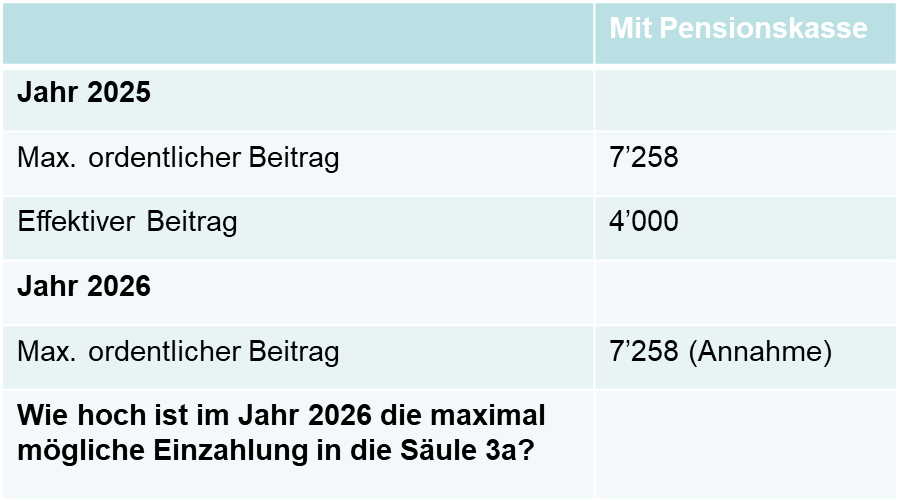
What is the maximum possible contribution to Pillar 3a in 2026?
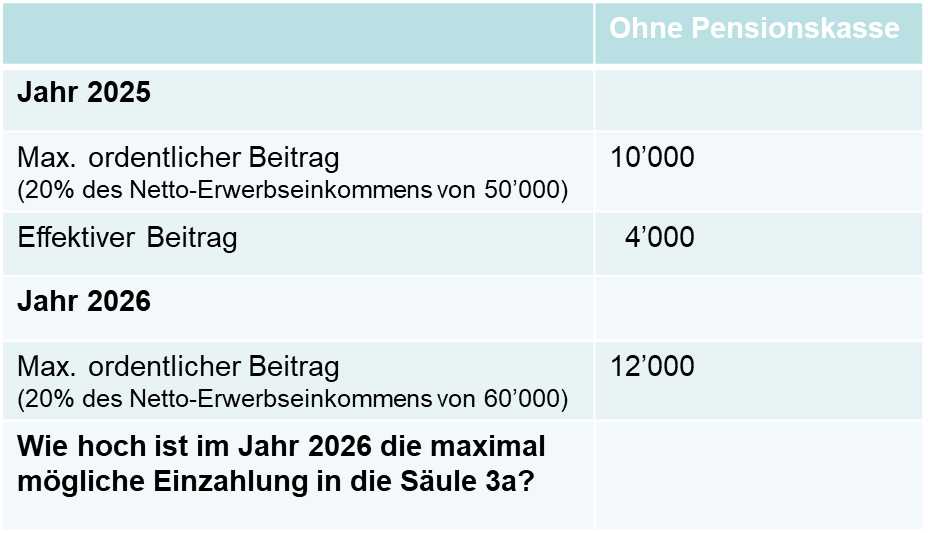
What will be the maximum possible contribution to Pillar 3a in 2026?
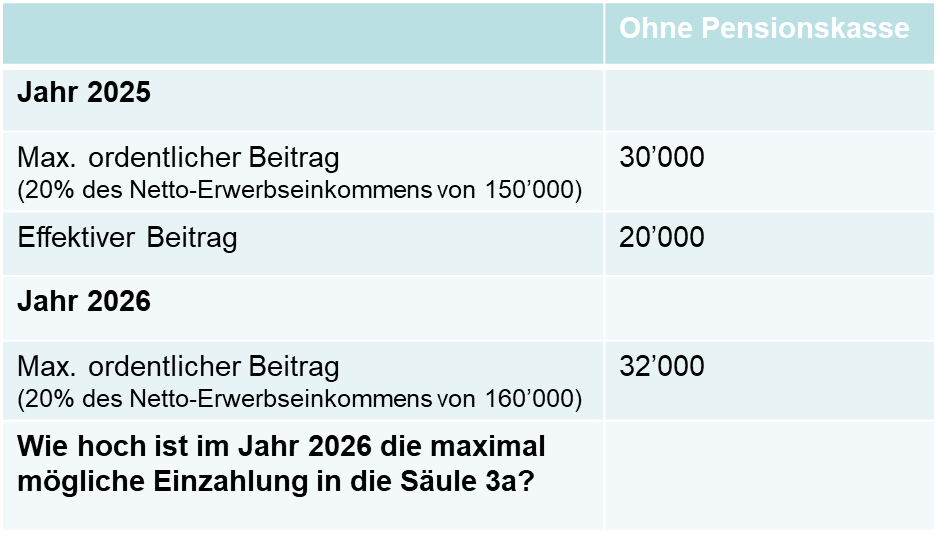
What will be the maximum possible contribution to Pillar 3a in 2026?
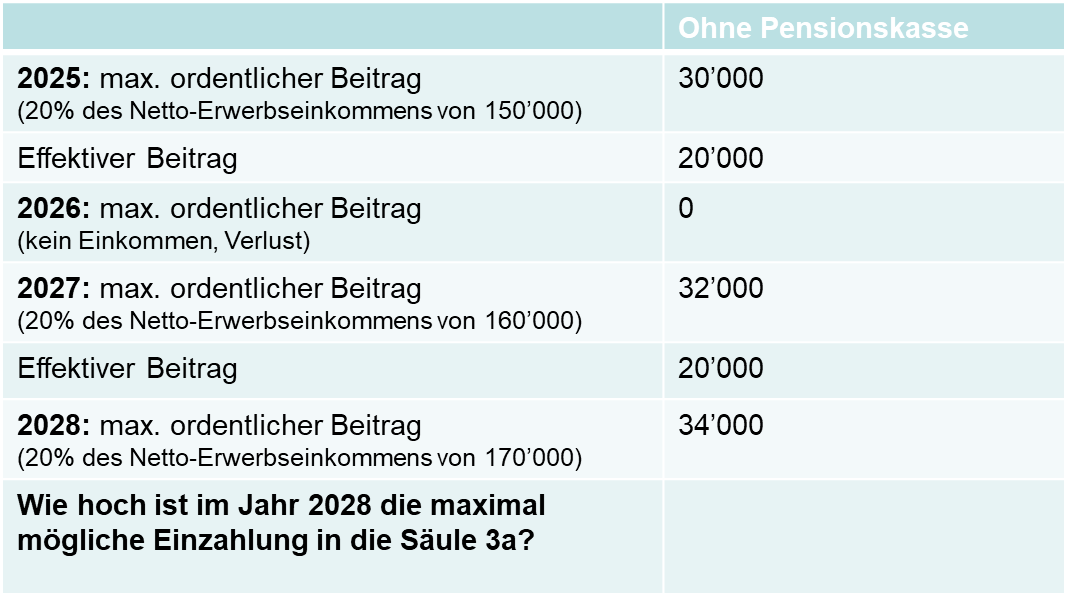
What will be the maximum possible contribution to Pillar 3a in 2028?
Mr. Müller is employed as a salaried worker until the end of February 2025 and earns a net income of CHF 20,000. He has his pension fund paid out at the beginning of March 2025 and is no longer employed thereafter.
What is the maximum contribution to Pillar 3a in 2025?
Mr. Müller is employed until the end of February 2025 and earns a net income of CHF 20,000. He has his pension fund paid out at the beginning of March 2025 but continues to work until the end of 2025 (income March–December: CHF 20,000), without being covered by a pension fund starting in March 2025.
What is the maximum contribution to Pillar 3a in 2025?
Mr. Müller is employed until the end of June 2025 and earns a net income of CHF 45,000. From July 2025 to June 2026, he is self-employed and earns CHF 100,000.
What is the maximum contribution to Pillar 3a in 2025?
Mr. and Mrs. W. (ages 54 and 55) have a total of four Pillar 3a accounts, two at each bank. Each Pillar 3a account holds approximately CHF 150,000.
Since the imputed rental value may be abolished and there is a threat of higher taxation on pension payouts, Mr. and Mrs. W. decide to pay off their mortgages and withdraw funds from the accounts via WEF early withdrawals as follows:
2025: Mrs. W. withdraws her funds from Account A at Bank A
2026: Mr. W. withdraws his account B from Bank B
2027: Mrs. W. withdraws her Account B from Bank B
2028: Mr. W. withdraws his Account A from Bank A
How is this treated for tax purposes?
On October 31, 2024, A (age 50) withdrew CHF 100,000 from his Pillar 3a bank account to pay off an expiring mortgage on his owner-occupied single-family home.
In January 2025, A received an offer from his primary bank for a lower interest rate on the renewal of another fixed-rate mortgage on his single-family home, which was set to expire on March 31, 2025, provided that the mortgage amount was increased by CHF 50,000. A accepted this offer.
Option 1: A increases the existing mortgage on his vacation home in Ticino by CHF 50,000 as of April 1, 2025.
Option 2: A increases the existing mortgage by CHF 50,000 as of April 1, 2025, to finance upcoming maintenance work on the single-family home.
Option 3: A increases the existing mortgage by CHF 50,000 as of April 1, 2025, to finance upcoming maintenance work on the vacation home in Ticino.
What are the tax consequences in the basic scenario and for the alternatives?
A (born in 1964) made a purchase of CHF 100,000 into his pension fund on January 31, 2025. The pension fund had previously confirmed to him that his purchase gap amounted to CHF 100,000. The purchase was financed from A’s freely available savings. On February 28, 2025, A closed a Pillar 3a account with a balance of CHF 110,000.
A closed the Pillar 3a account on January 31, 2025. He made the pension fund purchase on February 28, 2025.
10.3 Option 2:
On January 31, 2025, A requested the direct transfer of CHF 100,000 from his Pillar 3a account (balance: CHF 110,000) to his pension fund to finance the pension fund purchase.
What are the tax consequences in the basic scenario and in the two variants?
Swiss citizen X works as European Sales Manager for a Chinese (Alternative 1: a German) industrial company. X is domiciled in Switzerland and receives a fixed salary as an employee. Because the Chinese (German) company does not have a permanent establishment in Switzerland, it does not pay AHV contributions (Art. 12 AHVG). X. pays his AHV contributions himself pursuant to Art. 6 AHVG (so-called “ANOBAG”) or via an agreement pursuant to Art. 21 Regulation 987/2009.
Can X. contribute to a Pillar 3a account? If so, to what extent?